

Let me ask you something personal. When did you last sit with your thoughts for five full minutes — no phone, no scrolling, no checking? If that question made you slightly uncomfortable, you already understand what this article is about.
Social media did not start as a problem. It started as a genuinely useful idea — stay connected, share moments, find your people. Somewhere along the way, that idea got hijacked. Not by users. By design. The platforms we use every day were built, tested, and refined specifically to make it hard to stop. And the cost of that design is showing up in mental health data that nobody in the industry wants to talk about honestly.
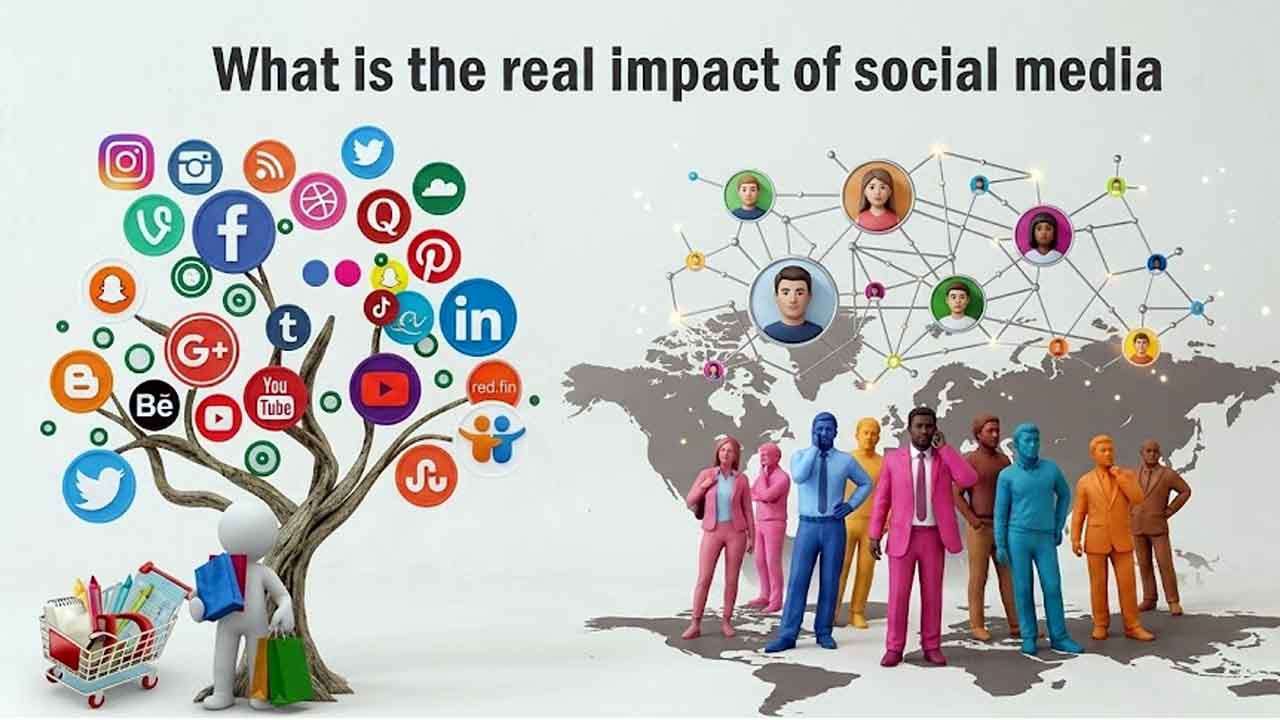
Over 4.9 billion people use social media globally as of 2024. That is more than 60% of the entire world population. The average person now spends around 145 minutes on social media every single day. Do the math across a lifetime, and you are looking at years — literal years — handed over to platforms that profit from your attention, whether it helps you or destroys you.
Social media addiction and mental health are not soft concerns for wellness blogs. It is a documented, measurable public health crisis. And if you are serious about performing at your best — in business, in leadership, in your personal life — this is something worth understanding deeply.
See Google reviews




How the Impact of Social Media Addiction on Mental Health Rewires the Brain
Here is something the platforms will never advertise. Every notification, every like, every comment triggers a dopamine release in your brain. Dopamine is the same neurochemical involved in gambling addiction and substance dependence. The brain does not distinguish between a slot machine payout and a sudden spike in post engagement. Both feel rewarding. Both create craving. Both eventually demand more stimulation to produce the same effect.
Social media platforms know this. Infinite scrolling was not a coincidence — it was a deliberate decision to remove natural stopping points. Algorithmic content delivery was not designed for your benefit — it was designed to keep you in a state of mild anticipation so you never quite feel satisfied enough to put the phone down.
Research measuring the impact of Social Media Addiction on Mental Health found a significant positive correlation between addiction levels and depression — r = 0.42, p < 0.001. Higher addiction, worse depressive symptoms. The direction is clear, and the data is consistent across multiple studies.
What makes this worse is something called the variable reward system. You never know what you will find when you open an app. Maybe five new likes. Maybe nothing. Maybe a hostile comment. That unpredictability is what creates compulsive checking. It is the same reason people keep pulling the lever on a slot machine even after they have already lost. Uncertainty amplifies craving in a way that predictable rewards simply do not.
View the website and YouTube channel:
https://www.youtube.com/@munirahmadpodcast/videos
Impact of Social Media Addiction on Mental Health: The Damage That Builds Slowly
The thing about this kind of damage is that it does not feel like damage at first. It feels like boredom relief. It feels like staying informed. It feels like being social. The harm accumulates in layers, quietly, until one day the anxiety is constant and the sleep is broken, and real conversations feel exhausting compared to scrolling.
What happens to anxiety and depression
A study tracking over 6,500 adolescents found that spending more than three hours daily on social media can double the risk of developing mental health problems like anxiety and depression. Among young adults assessed for social media addiction, 34% scored in the high addiction range — and those individuals consistently showed worse scores on depression assessments.
The mechanism is straightforward, even if the experience feels confusing. Constant exposure to carefully edited versions of other people’s lives creates a distorted baseline. The brain starts treating these curated highlights as normal. Then it measures your actual life against that baseline. The gap produces dissatisfaction, and dissatisfaction sustained over months and years looks a lot like depression.
What happens to self-esteem
Research confirms a significant negative correlation between Impact of Social Media Addiction on Mental Health and self-esteem — r = -0.35, p < 0.01. Higher addiction levels are associated directly with lower self-worth. This is especially dangerous for people in their late teens and early twenties, when identity is still forming, and external validation carries enormous psychological weight.
The pattern becomes self-reinforcing. Low self-esteem drives more social media use because the platforms offer cheap, fast validation. More social media use further erodes self-esteem through comparison and rejection. The cycle continues.
Research data also shows that women are hit harder by this than men. Gender-wise distribution in cross-sectional studies consistently places more females in the lower self-esteem and higher depression categories compared to males. The pressure of idealized beauty standards, filtered images, and performative perfection creates a particular kind of psychological weight that is difficult to carry indefinitely.
The loneliness that hides behind connection
There is a cruel irony at the center of social media addiction. The more someone uses it to feel connected, the lonelier they actually become. Studies confirm that high usage of Facebook, Instagram, and Snapchat increases feelings of isolation rather than reducing them. Real human connection — face to face, eye to eye — is what the nervous system actually needs to regulate stress and sustain emotional health. Digital interaction can supplement that. It cannot replace it.
Warning Signs Worth Taking Seriously
How do you know when use has crossed into addiction territory? The honest answer is that most people do not notice until the consequences are already visible.
Do you check your phone first thing in the morning before your feet hit the floor? Do you feel a specific kind of restlessness or irritability when you cannot access social media for a few hours? Has your sleep gotten worse? Are real conversations starting to feel like an effort? Do you scroll to avoid feelings rather than because you actually want to?
These are not personality flaws. They are signs of a system that was built to create exactly this response. The platforms invest billions into behavioral psychology research specifically to make these patterns harder to break. Recognizing the signs is not about shame — it is about clarity.
The broader numbers add urgency here. Over the last 25 years, anxiety and depression prevalence among young people has risen by 70%. The timeline matches the spread of smartphones and social platforms closely enough that researchers across multiple institutions have moved well past debating correlation.
The FOMO Trap and How It Keeps You Scrolling
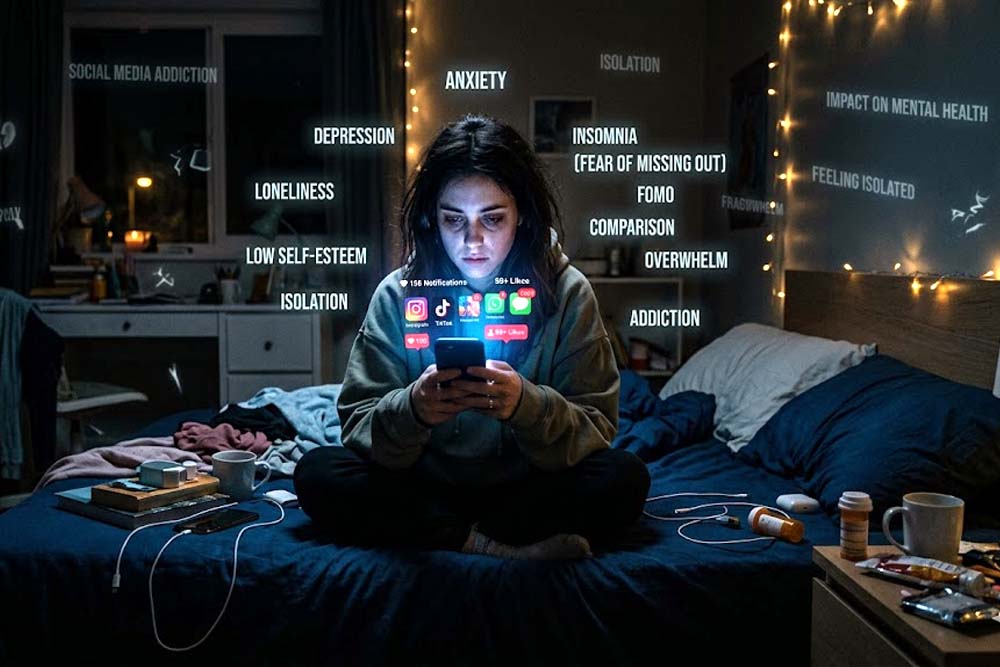
FOMO — fear of missing out — is one of the oldest human anxieties given a modern delivery mechanism. The fear that other people are living better, achieving more, connecting more meaningfully has always existed. Social media simply made it available 24 hours a day on a screen small enough to carry in your pocket.
The problem is that social media is a highlight reel, and the brain treats it as a documentary. Nobody posts on their ordinary Tuesday. Nobody shares the anxiety before a presentation or the argument with their partner, or the three hours they spent doing nothing useful. What gets posted is the travel photo, the promotion announcement, the flattering angle. The brain absorbs all of it and concludes that everyone else is doing remarkably better.
Research from 2024 found that using platforms primarily for passive information consumption can actually increase feelings of outrage — because algorithms deliberately surface content that generates emotional reactions. Anger, disgust, and anxiety keep people on the platform longer than contentment does. The system is not neutral. It actively selects for emotional activation because activated users are engaged.
Impact of Social Media Addiction on Mental Health — What Major Institutions Now Confirm
It is worth being direct about where official positions now stand, because this conversation moved out of academic debate and into institutional action some time ago.
The American Psychological Association has documented a direct correlation between high social media use and poor mental health outcomes in adolescents. The U.S. Surgeon General publicly called on social media companies to prioritize user well-being over engagement metrics. New York City classified social networking sites as a public health threat and filed lawsuits against TikTok, Meta, Snap, and YouTube — naming them directly responsible for fueling a youth mental health crisis.
The American Academy of Pediatrics has stated that media use and screen time are associated with increased risks, including attention deficits, increased aggression, low self-esteem, and depression. These are not fringe positions from wellness advocates. These are statements from mainstream medical and governmental institutions responding to a body of evidence they can no longer minimize.
On the cognitive side, research has documented that excessive social media use reduces attention span and impairs the ability to sustain focus on complex tasks. Educational performance suffers. The capacity for deep, uninterrupted thinking — which is the foundation of real professional and creative output — erodes with sustained heavy use.
What Actually Works: Strategies With Evidence Behind Them
The research literature is useful here because it moves past generic advice toward approaches that actually change behavior.
Cognitive Behavioral Therapy
CBT is among the best-evidenced interventions for compulsive social media use. It works by helping people identify the specific thought patterns and emotional triggers that drive excessive use — not social media in general, but the particular moments and feelings that push a specific person toward their phone. From there, healthier responses are built deliberately. CBT does not ask people to white-knuckle their way through cravings. It changes the underlying pattern.
Mindfulness applied to digital behavior.
Mindfulness in this context means something specific. It means developing the capacity to notice the urge to check social media before acting on it. That gap — between urge and action — is where real change happens. When the gap does not exist, behavior is automatic. When it exists, behavior is chosen. Pairing mindfulness practice with practical limits like designated offline hours and notification management creates results that are measurable and sustainable.
Active use over passive consumption
Research consistently shows that passive social media use — scrolling without engaging — correlates more strongly with negative mental health outcomes than active use like commenting, creating, and genuine conversation. Doom scrolling deserves its name. Deliberately shifting toward purposeful, active engagement and regularly auditing which accounts actually make you feel better versus worse, produces a meaningfully different experience on the same platforms.
Reducing screen time with intention
Studies confirm that even modest reductions in daily social media use produce improvements in well-being, lower feelings of loneliness, and better sleep. The replacement matters too. Activities that create genuine satisfaction — physical movement, in-person connection, creative work, time outdoors — rebuild the emotional reserves that passive scrolling consistently drains without replenishing.
Personal Branding Changes the Relationship With Social Media
There is a version of social media use that does not hollow people out. Professionals and entrepreneurs who approach personal branding with a genuine strategy use platforms as tools for communication and value delivery rather than as sources of self-worth. The psychological shift that comes from showing up online with a clear purpose — here is what I know, here is who I serve, here is what I stand for — is genuinely protective.
When your identity is grounded in your expertise, your track record, and your real-world results, follower counts lose their grip. Comparison loses its sting. The platform becomes a vehicle rather than a mirror. That is not just a better business strategy. It is a meaningfully healthier way to exist in digital spaces.
Why Mindset Is the Foundation of All of This
Mental health is not only about removing harmful inputs. It also requires building something — specifically, the psychological resilience to navigate pressure without fracturing. This is a core reason why organizations and individuals invest in motivational speaking and leadership development — not as inspiration theater, but as serious work on the mental frameworks that determine how people respond to difficulty.
A resilient mindset approaches social media from a position of security rather than need. It does not require external validation to feel capable. It engages with platforms on its own terms. It treats comparison not as evidence of inferiority but as a cognitive distortion that can be recognized and set aside. That kind of internal architecture is learnable. It takes real work. But it is the most durable protection available against the kind of slow erosion that the impact of Social Media Addiction on Mental Health causes.

Final Thoughts
The Impact of Social Media Addiction on Mental Health is not going to resolve on its own. The platforms are not going to redesign themselves for your psychological safety. The business model depends on your attention, and your psychological vulnerabilities make your attention easier to capture and hold. The anxiety, the broken sleep, the low self-worth, the background loneliness — these are not bugs in the system. They are the predictable output of a machine running exactly as designed.
The response is not to abandon technology. It is to stop being passive about it. Use it with a clear reason. Build something real through it. Know when to put it down. And if the compulsive patterns feel too embedded to shift on your own, seek professional support — because this is a real psychological challenge that responds to real psychological intervention.
Your mental clarity and emotional stability are not soft assets. They are the foundation of every meaningful thing you do professionally and personally. Protect them accordingly.
People also ask
What is social media addiction?
Social media addiction is compulsive, uncontrolled use of social media platforms that interferes with daily responsibilities, relationships, and emotional well-being — despite awareness that the behavior is causing harm.
How does social media addiction affect mental health?
It is directly linked to higher rates of anxiety and depression, lower self-esteem, disrupted sleep, reduced attention span, and chronic feelings of loneliness. The core mechanism is a dopamine-driven reward loop that creates compulsive checking behavior structurally similar to other behavioral addictions.
Who is most at risk?
Adolescents and young adults between 18 and 25 face the highest risk, particularly those with pre-existing anxiety, depression, or low self-esteem. Research consistently shows that females experience disproportionately higher rates of depression and self-esteem damage linked to social media use.
Can social media addiction be treated effectively?
. Cognitive Behavioral Therapy, mindfulness-based approaches, structured digital boundaries, and intentional changes to usage patterns all have consistent evidence of effectiveness. The key is addressing the underlying emotional triggers, not just the behavior itself.
How much daily use crosses into harmful territory?
Spending more than three hours daily on social media has been associated with a doubled risk of mental health issues in research on adolescents. But time alone is not the full measure — the more important question is whether the behavior is interfering with sleep, focus, relationships, and emotional stability.