

Think about the last time your business ran a PR campaign. Did you know with real numbers, whether it worked?
Most business owners invest in public relations, wait for media coverage, and then move on. The problem is that gut feelings and press clippings do not tell the full story. A 2025 State of PR Measurement report reveals that 81% of PR professionals measure their work, yet 61% do not follow any formal measurement framework. That gap is expensive — and it is exactly where most businesses lose money without knowing it.
After more than 20 years of working in business consulting and digital strategy across global markets, the pattern is clear. The businesses that win are not always the ones with the biggest PR budgets. They are the ones who know what is working and why. Munir Ahmad’s PR measurement framework gives you that clarity — step by step, metric by metric.
See Google review




Why Most PR Campaigns Fail the Measurement Test
It is important to understand one thing first: a PR campaign without measurement is not a strategy. It is a guess dressed in a press release.
According to a USC Annenberg Global Communications report, 78% of CMOs now demand specific, quantifiable proof of PR’s value before approving budgets. Yet only 34% of PR teams have the tools and frameworks to deliver that proof. The result? PR departments get cut. Campaigns get repeated without improvement. Budgets shrink.
The good news is that measurement is not complicated. It requires the right framework and a willingness to connect your PR activity to actual business outcomes.
Ask yourself this: Do you currently know how many leads your last press mention generated? Do you know whether your brand sentiment improved after your last campaign? If the answer is no, keep reading.
What Measure PR Campaign Success Actually Means
Measuring PR campaign success is the process of tracking and analyzing your public relations efforts to determine their real impact on your brand, audience, and business goals.
It goes far beyond counting newspaper clippings or social media likes. Real PR measurement looks at how your campaign moved the needle on things that matter — brand awareness, customer trust, lead generation, and revenue.
The Barcelona Principles, an internationally recognized standard for PR measurement, state clearly that outcomes must be linked to business objectives. Volume of coverage alone does not qualify as success.
Here is what a complete PR measurement plan covers:
- Media reach and impressions tracked against defined benchmarks
- Audience sentiment before, during, and after the campaign
- Website traffic and referral sources tied to PR placements
- Lead generation and conversion data connected to earned media
- Share of voice relative to competitors in the same space
Set Your Goals Before You Measure Anything
Start With Business Objectives, Not PR Objectives
The first step in Munir Ahmad’s framework is deceptively simple — align your PR goals with your business goals before the campaign starts. Many PR teams skip this step and then struggle to explain their results later.
Ask what the business needs right now. Is it brand awareness to attract investors? Is it thought leadership to bring in corporate clients? Is it reputation repair after a public setback? Each goal requires different metrics.
A business owner trying to scale needs different PR measurement than a personal brand builder trying to attract speaking engagements or consulting clients. The framework must match the goal.
Define Your KPIs Before Launch
A Key Performance Indicator (KPI) is not the same as a metric. A metric tells you what happened — your article received 5,000 views. A KPI tells you whether it mattered — those 5,000 views generated 80 consultation requests, which converted into six new clients.
Before any measure PR campaign success goes live, define at least three KPIs tied to your business outcome. For example:
- A personal brand builder might track executive mentions in top-tier publications
- A business consultant might track inbound leads from earned media
- A corporate speaker might track speaking invitation requests after a media feature
This level of specificity makes your measurement report meaningful to stakeholders and decision-makers.
The 6 Core PR Metrics You Must Track
Media Impressions and Reach
Impressions refer to how many times your content appeared in front of an audience. Reach refers to how many unique individuals saw it. The distinction matters.
One million impressions from the same 50,000 people is not the same as 500,000 unique readers across new markets. Track both numbers using media monitoring tools like Cision, Meltwater, or Brand24.
For businesses in Pakistan and across South Asia, regional media reach deserves special attention. A feature in a major Urdu-language outlet may carry more commercial weight than coverage in an international publication with no local relevance.
Media Sentiment Analysis
Sentiment analysis measures the emotional tone of your media coverage — positive, negative, or neutral. It is one of the most underused PR metrics among small and mid-sized businesses.
A press mention that misrepresents your brand or carries a skeptical tone can do more harm than good. Sentiment analysis catches these cases and allows your PR team to respond or adjust the campaign strategy.
AI-powered tools now make sentiment tracking faster and more accurate. Real-time sentiment monitoring is particularly valuable during crisis communication situations, which is a service Munir Ahmad specializes in for corporate clients.
Website Traffic From Earned Media
Every measure of PR campaign success must drive traffic that you can actually trace back to a specific source. The tool for that is UTM parameters — short tracking tags you add to your links before sharing them with any media outlet, influencer, or publication.
Google Analytics is where all that data lands. Each outlet gets its own UTM link. After two weeks, you open the report, and you know — not guess — which publication sent real visitors and which one sent people who left in five seconds.
Real traffic has a pattern. Visitors from a strong PR placement stay longer, go deeper into the site, and end up on your services page or contact form. Low-intent traffic bounces fast. The UTM data makes the difference obvious, and that clarity saves money on future campaigns.
Lead Generation and Conversions
Here is where PR stops being a brand exercise and starts being a revenue driver. A conversion is not just a click or a visit — it is a person who came through a PR touchpoint and then did something that matters to your business. That could mean a consultation request, a product purchase, an event sign-up, or even just a newsletter subscription that eventually leads to a sale.
The way to track all of that is through goal setup in Google Analytics and proper tagging inside your CRM. Once those two systems talk to each other, you start seeing real patterns. Some media outlets send visitors who convert at 8%. Others send hundreds of visitors who never come back. That data tells you exactly where to invest your next PR budget.
In practice, business owners who work through Munir Ahmad’s consulting framework often find that two or three specific media relationships drive the majority of their PR-linked conversions. The rest is noise — and measurement is how you tell the difference.
Share of Voice
Share of voice measures how much of the media conversation in your industry belongs to your brand versus your competitors. It is expressed as a percentage.
If your brand appears in 30% of all coverage on business consulting in Pakistan while your three main competitors share the other 70%, your share of voice is 30%. The goal is to grow that share over time through consistent, strategic PR activity.
Tools like Brand watch and Mention track share of voice automatically across digital platforms.
ROI — The Number That Silences Every Skeptic
Return on Investment is the metric that makes PR defensible in any boardroom. To calculate PR ROI, divide the monetary value generated by the campaign by the total cost of the campaign.
For example, if a PR campaign cost Rs. 500,000 and generated leads worth Rs. 2,500,000 in closed business, the ROI is 5x or 400%.
Attribution is the hard part — and nobody should pretend otherwise. PR touches a person’s awareness long before they make a decision, so pinning a sale to a specific press mention takes effort. UTM tracking handles the digital trail. CRM tags tell you how a lead first heard about you. Post-purchase surveys ask directly. No single method is perfect, but together they give you a defensible number to put in front of any stakeholder.
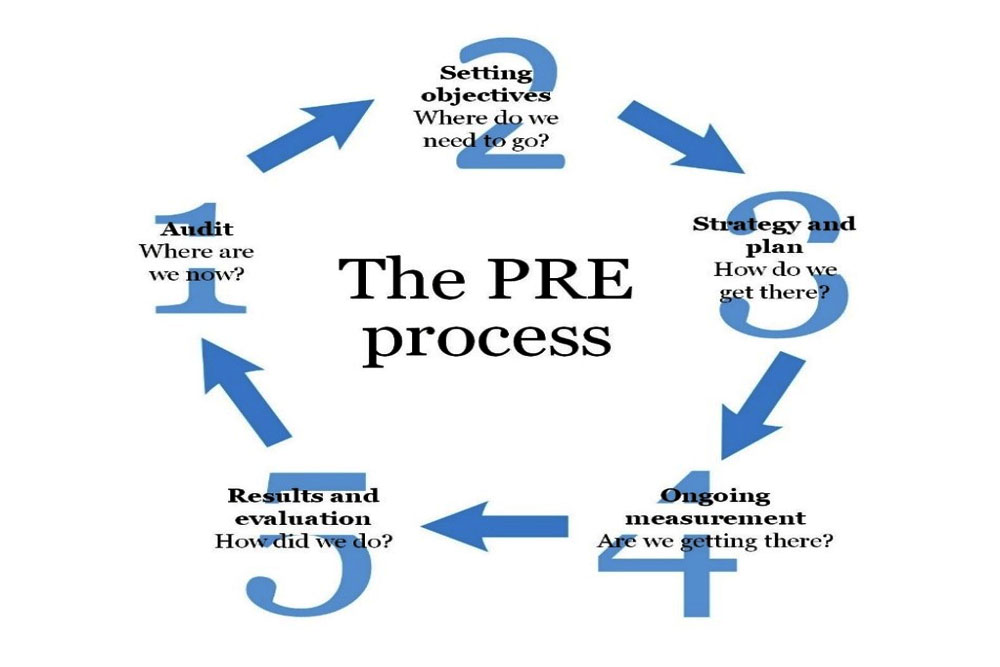
Munir Ahmad’s 4-Stage PR Measurement Process
Twenty years of consulting work across Pakistan, the Middle East, and international markets taught one consistent lesson — campaigns without a measurement structure repeat the same mistakes. The four stages below remove that problem.
Baseline Audit
Before the campaign launches, document everything that currently exists. Pull your last three months of website traffic data. Note your current media mention count and sentiment score. Record your social media follower numbers and your monthly lead volume. All of that becomes your benchmark. Every metric after the campaign runs gets compared against it.
Mid-Campaign Pulse Check
Halfway through the campaign, sit down with your data. Look at where sentiment stands. Check whether the media outlets covering your story are actually reaching the audience segments you targeted. If something is off — a message falling flat, a channel underperforming — the mid-point is still early enough to fix it. Most teams skip this step and then wonder why the final report looks weak.
Post-Campaign Analysis
Once the campaign ends, compare every metric against your baseline. Did brand awareness move? Did lead volume increase? Did referral traffic from earned media hold up over time? Pull the results side by side against the KPIs you set before launch. The gaps between the two tell you exactly what worked and what did not.
Strategic Recommendations
Data without a decision is just a report. The fourth stage turns your analysis into a plan. Which media channels brought the best results? Which messages connected most with the audience? Which KPIs were missed, and what caused that gap? The answers feed directly into your next campaign — so each round of PR gets more precise and more cost-effective than the last.
Tools to Make PR Measurement Manageable
The right tools remove the guesswork from PR measurement. Here are the ones worth knowing:
- Google Analytics 4 — tracks website traffic, referral sources, and conversions
- Brand24 — monitors brand mentions across news sites, blogs, and social media
- Cision or Meltwater — enterprise-level media monitoring with sentiment analysis
- SEMrush or Ahrefs — tracks backlinks earned from PR placements and their SEO impact
- HubSpot CRM — connects media-driven leads to sales pipeline data
For businesses at the early stages of PR measurement, starting with Google Analytics and one media monitoring tool is enough. Add tools as your measurement practice matures.
PR Measurement for Personal Brands and Influencers
If you are a personal brand builder or influencer — and many of Munir Ahmad’s clients fall into this category — PR measurement looks slightly different.
The core goal is authority. Your metrics should reflect how consistently you are being recognized as an expert in your field. Key things to track include:
- Thought leadership mentions in relevant publications
- Speaking invitation requests generated from media features
- Social media follower growth tied to press coverage
- Engagement rates on content that references media appearances
Personal brand PR is not just about visibility. It is about the right visibility in front of the right audience — investors, corporate clients, media producers, and potential partners.
Communicating Your PR Results to Stakeholders
The best PR measurement report in the world means nothing if stakeholders cannot understand it. Here is how to present your results clearly:
Start with the business outcome, not the media activity. Instead of leading with “We secured 47 media mentions,” lead with “Our measure PR campaign success generated 120 qualified leads and contributed to a 22% increase in consultation bookings.”
Use visual dashboards. Charts and graphs make data accessible to non-technical stakeholders — business owners, investors, and board members who care about results, not processes.
Connect every metric back to the KPIs defined before the campaign. If you hit the KPIs, explain why. If you missed them, explain what you learned and how the next campaign will address it.
Transparency builds trust with stakeholders. Stakeholders who trust the PR measurement process are far more likely to approve future budgets and expand PR activity.

Final Thoughts
Measure PR campaign success measurement is not a back-office reporting task. It is a strategic function that determines whether your brand investment pays off — or silently drains your budget.
The framework outlined above works for business owners scaling their companies, professionals building personal brands, corporate clients investing in reputation management, and influencers seeking structured authority in their markets. The principles remain the same: start with business goals, define KPIs, track the right metrics, and translate data into decisions.
Over 20 years of working across global markets, one truth stays consistent — the businesses that measure PR properly are the businesses that get to run more PR. They have the data to justify the investment, the insights to improve every campaign, and the results to silence every skeptic.
If your brand is ready to move from guesswork to a measurement-driven PR strategy, it is time to bring in experienced guidance.