

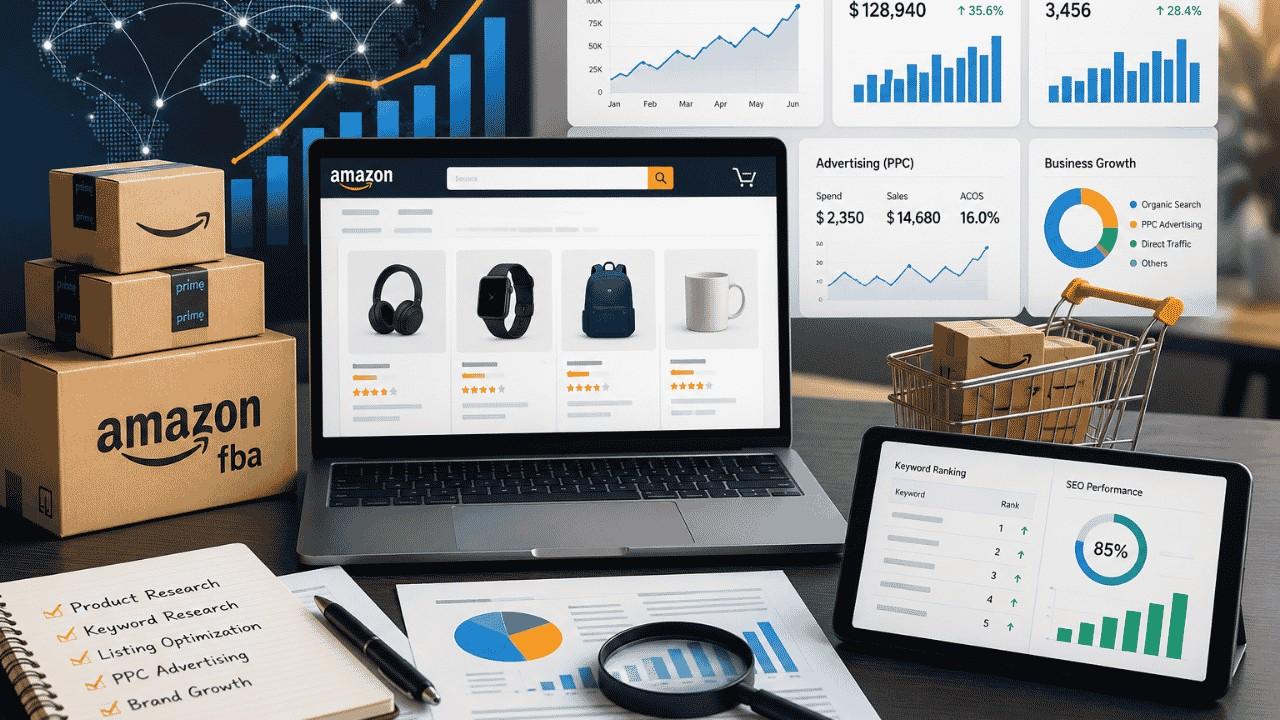
Amazon ecommerce is the practice of selling products through Amazon’s marketplace — either as a third-party seller, a private label brand, or via Fulfillment by Amazon (FBA). If you’re serious about building a profitable online business, working with a qualified ecommerce specialist can save you months of trial and error. With over 2 million active third-party sellers on the platform and Amazon controlling nearly 38% of all U.S. ecommerce sales, the opportunity is real — but so is the competition.
Whether you’re a first-time seller or a brand that’s been on Amazon for years, this guide covers everything from setting up your store to scaling with data. You’ll learn what your competitors are doing, what they’re missing, and how to position yourself for long-term success.
Google review




What Is Amazon Ecommerce and Why Does It Still Matter?
Amazon ecommerce started in 1995 with Jeff Bezos selling books out of his garage. Fast-forward to today: Amazon is a $2 trillion company, AWS powers a third of the internet, and its marketplace has become the go-to starting point for product searches — even ahead of Google in many categories.
For sellers, the math is straightforward. Amazon brings the traffic; you bring the product. You don’t have to build an audience from scratch or pay for a brand website before your first sale. That’s why Amazon’s ecommerce products, ranging from phone accessories to supplement stacks, are generating seven-figure revenues for individual entrepreneurs every year.
But here’s what most guides won’t tell you: Amazon’s algorithm, fee structure, and competitive landscape have all changed significantly. If you’re still following advice from 2020, you’re behind.
Amazon Ecommerce Process: From Account Setup to First Sale
Understanding the Amazon ecommerce process end-to-end is the single most important thing you can do before spending a dollar. Here’s how it actually works:
Step 1 — Choose Your Selling Plan
| Plan | Monthly Fee | Per-Item Fee | Best For |
| Individual | $0 | $0.99/item | Beginners, <40 sales/month |
| Professional | $39.99 | None | Serious sellers, volume businesses |
The Professional plan unlocks advertising, restricted categories, and advanced reporting. Most serious Amazon ecommerce business owners switch to Professional within their first 90 days.
Step 2 — Decide Your Business Model
Before listing a single product, you need to know which model you’re running. Each has different startup costs, margins, and risk profiles.
| Model | Startup Cost | Margin Potential | Control Over Brand |
| Private Label | High ($2,000–$10,000+) | High (30–60%) | Full |
| Wholesale | Medium ($1,000–$5,000) | Medium (15–30%) | None |
| Retail Arbitrage | Low ($200–$1,000) | Low-Medium (10–25%) | None |
| Dropshipping | Very Low | Low (5–15%) | None |
| Amazon FBA (own brand) | Medium-High | High | Full |
Private label is widely considered the most sustainable model for building an Amazon ecommerce business long-term. You create (or source) a product, brand it, and list it under your own name.
Step 3 — Product Research
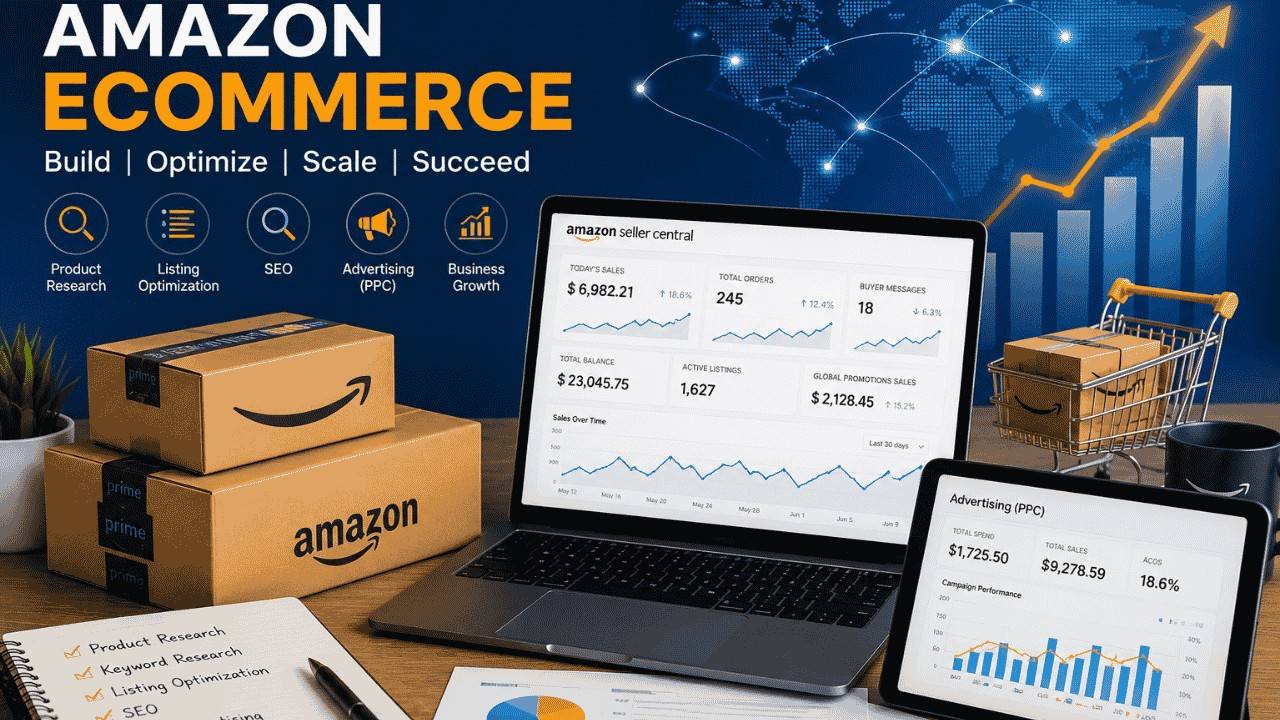
This is where most sellers fail. They pick a product they like rather than a product the data supports. Use tools like Helium 10, Jungle Scout, or Keepa to analyze:
- Monthly search volume for target keywords
- Average selling price and estimated margins after fees
- Number of reviews on top competitors (tells you how mature the niche is)
- Seasonality — does demand spike and crash?
A good product for an Amazon ecommerce business typically has 1,000–10,000 monthly searches, at least a $25 selling price, fewer than 500 reviews on page-one competitors, and year-round demand.
Step 4 — Source Your Product
For private label sellers, sourcing usually means working with manufacturers on Alibaba, Global Sources, or through trade fairs. Key considerations:
- Minimum Order Quantity (MOQ) — can you afford it?
- Lead time — how long before stock arrives at Amazon?
- Quality control — who’s checking the goods before they ship?
Step 5 — Create Your Listing
Your listing is your storefront. A weak listing is money left on the table. Every element matters:
Title: Include your primary keyword naturally within the first 80 characters
Bullet points: Lead with the benefit, fFollow with the feature
Product description / A+ Content: Tell a story; explain why this product exists
Images: Amazon recommends at least 7 images; include lifestyle shots, infographics, and size reference images
Backend keywords: Fill every character — this is free SEO real estate
Step 6 — Choose Fulfillment: FBA vs FBM
| Factor | FBA (Fulfillment by Amazon) | FBM (Fulfilled by Merchant) |
| Storage | Amazon’s warehouse | Your own |
| Shipping speed | Prime-eligible | You control |
| Fees | FBA fees + storage fees | Lower fees, but more work |
| Returns | Handled by Amazon | You handle |
| Best for | High-volume sellers | Low-volume or oversized items |
FBA is the default recommendation for most Amazon ecommerce products because it makes your listings Prime-eligible, which dramatically boosts conversion rates.
Amazon Ecommerce Pakistan: A Growing Opportunity
Amazon’s ecommerce in Pakistan has been a hot topic since Amazon officially added Pakistan to its list of approved seller countries in 2021. This was a turning point for entrepreneurs across Lahore, Karachi, and Islamabad who had been waiting years for this access.
Here’s what Pakistani sellers need to know:
Setting Up Your Account from Pakistan
You’ll need a valid CNIC or passport, a US-based bank account (many sellers use Payoneer, which integrates directly with Amazon), a registered business (sole proprietorship works), and a US phone number for verification.
Popular Product Categories for Pakistani Sellers
Pakistan has a strong manufacturing base in textiles, leather goods, sports equipment (Sialkot is a global hub), and surgical instruments. These are genuine competitive advantages. Many successful Pakistani Amazon sellers source locally and sell globally — turning domestic manufacturing costs into international margins.
Challenges to Know
Payment delays, account verification hurdles, and limited access to Amazon’s advertising tools at launch are real friction points. Working with someone who’s navigated these specifically — like an experienced ecommerce specialist based in Pakistan — shortens the learning curve considerably. Munir Ahmad has over 20 years of experience working with multiple companies, spoken at industry events, and hosts the Munir Ahmad Podcast with 2,900+ videos on YouTube dedicated to helping entrepreneurs like you navigate exactly these challenges.
Amazon FBA: Everything You Need to Know
Fulfillment by Amazon changed the game when it launched in 2006. Instead of warehousing products yourself, you ship inventory to Amazon’s fulfillment centers, and they handle storage, picking, packing, shipping, and customer returns.
FBA Fee Breakdown (2026)
| Fee Type | What It Covers | Approximate Cost |
| Referral fee | Amazon’s commission per sale | 8–15% of sale price |
| FBA fulfillment fee | Picking, packing, shipping | $3.22–$6.92+ per unit |
| Monthly storage fee | Warehousing your inventory | $0.78–$2.40/cubic foot |
| Long-term storage fee | Items stored 365+ days | $6.90/cubic foot |
The most common mistake new FBA sellers make is ignoring storage fees. If your product doesn’t move, those fees compound. Aim for an inventory turnover ratio of at least 4x per year.
FBA vs FBM: When to Switch
FBM makes more sense for oversized or heavy items where FBA fees eat the margin, products with slow turnover, and sellers who want more control over the customer experience (branded packaging, personal notes, etc.).
Building a Private Label Brand on Amazon
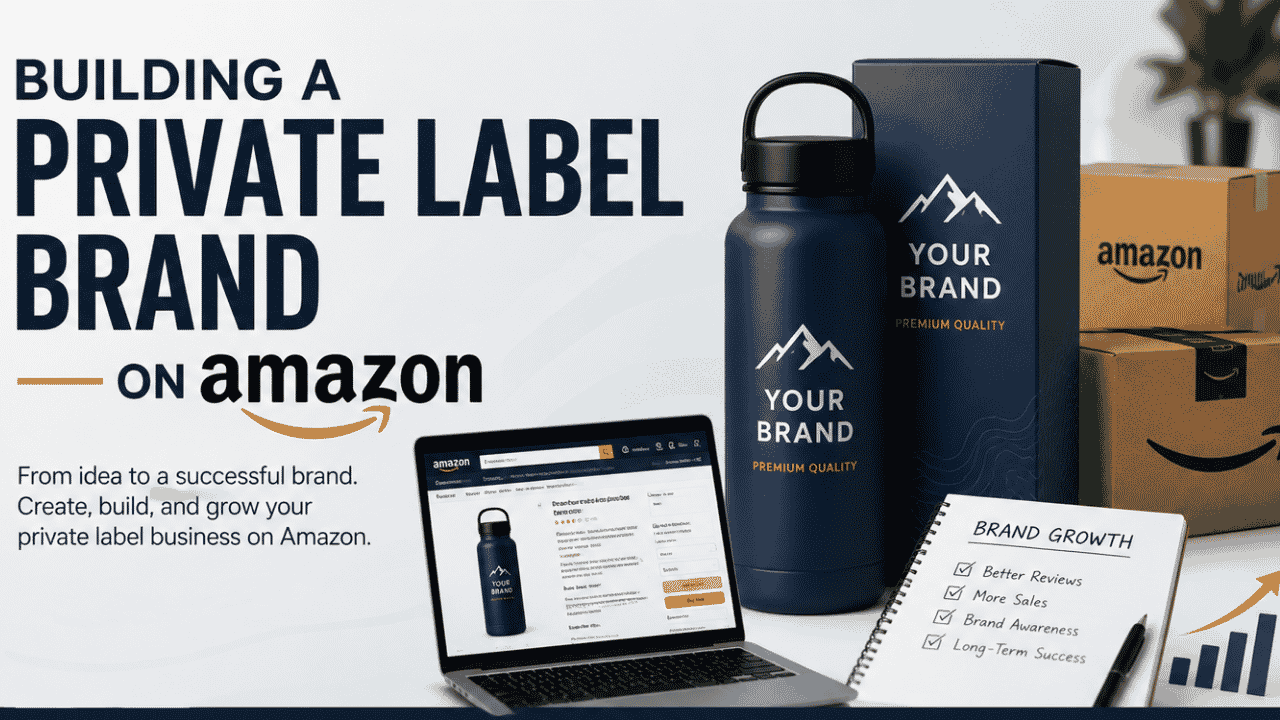
Private label is where most serious Amazon ecommerce business owners eventually land. The idea is simple: source a generic product, improve it based on customer reviews and market gaps, brand it as your own, and build a real asset.
Here’s a realistic timeline for a private label launch:
Month 1–2: Product research, niche validation, supplier sourcing
Month 2–3: Sampling, quality checks, branding (logo, packaging)
Month 3–4: Listing creation, A+ Content, photography
Month 4–5: Inventory shipped to Amazon FBA
Month 5–6: Launch phase — PPC ads, early review strategy, keyword ranking
By month 6, a well-executed private label product can be generating consistent sales. Scaling to $10,000/month and beyond typically requires reinvesting profits into more inventory and advertising.
Amazon SEO: How to Rank Your Products
Amazon is a search engine. Treat it like one. The A9 (now A10) algorithm ranks products based on two primary signals: relevance and performance.
Relevance is determined by how well your listing matches what someone is searching for. This is influenced by your title, bullets, description, and backend keywords.
Performance is determined by your conversion rate, click-through rate, and sales velocity. A product that sells well gets ranked higher, which makes it sell even better. This virtuous cycle is why getting your launch strategy right matters so much.
Keyword Research for Amazon
The keyword strategy for Amazon ecommerce products is different from Google SEO. Buyers on Amazon are closer to the purchase decision, so keywords are more transactional. Use tools like Helium 10’s Cerebro or Magnet to find:
- High-volume, low-competition keywords
- Long-tail variants that convert well
- Competitor keywords you’re not targeting yet
Weave your primary keyword into the title (front-loaded), one or two bullets, and the product description. For Amazon e-commerce seo Pakistan sellers, adding regional context to listings (where relevant) can also help with import/export queries.
Amazon Advertising: PPC Strategy for New and Experienced Sellers
Amazon PPC (Pay-Per-Click) is the most direct way to drive traffic to your listings. There are three main ad types:
Sponsored Products — appear in search results and on product pages. Best for driving direct sales.
Sponsored Brands — appear at the top of search results with your logo and multiple products. Best for brand awareness.
Sponsored Display — retargeting ads that follow shoppers across Amazon and beyond.
For a new Amazon ecommerce business, the typical starting approach is:
- Launch Sponsored Products with automatic targeting first to gather data
- After 2–3 weeks, mine that data for high-performing keywords
- Move top keywords to manual campaigns with tighter bid control
- Gradually build out Sponsored Brand campaigns as your review count grows
Target an ACOS (Advertising Cost of Sale) of 25–35% during the launch phase. As your organic ranking improves, your PPC dependency should decrease.
People also ask
How much does it cost to start an Amazon ecommerce business?
Realistic startup costs range from $2,000 to $10,000 for a private label launch, accounting for product samples, inventory, photography, and initial advertising. Retail arbitrage can start for under $500.
Can I do Amazon ecommerce from Pakistan?
Yes. Since Amazon added Pakistan as an approved seller country in 2021, Pakistani entrepreneurs can register as sellers, list products, and receive payments via Payoneer. The Amazon ecommerce Pakistan ecosystem is growing rapidly, with communities in Lahore, Karachi, and Islamabad actively supporting new sellers.
What are the best Amazon ecommerce products to sell?
Products priced between $25–$80, with manageable size and weight (to keep FBA fees in check), in niches with consistent year-round demand and fewer than 500 reviews on page-one competitors tend to perform best.
What’s the difference between FBA and dropshipping on Amazon?
FBA means you own and store the inventory; Amazon ships it. Dropshipping means the supplier ships directly to your customer when an order is placed. Amazon allows dropshipping but has strict rules — you must be listed as the seller of record, and the supplier cannot ship with their own branding.
How do I grow an Amazon ecommerce business in Pakistan?
Focus on product categories where Pakistan has a manufacturing advantage (textiles, sports goods, leather), invest in professional photography and listing optimization, run PPC campaigns from day one, and consider consulting with an experienced ecommerce specialist to navigate platform-specific challenges.
Final Thoughts
Amazon’s e-commerce is not a get-rich-quick scheme. It’s a real business that rewards sellers who do the research, optimize their listings, manage their cash flow, and play the long game. The platform gives you access to hundreds of millions of buyers — but the sellers who win are the ones who treat it with the same seriousness as any other business.
Whether you’re exploring amazon ecommerce Pakistan opportunities, launching your first amazon ecommerce products as a private label brand, or trying to scale an existing amazon ecommerce business, the path is clear: master the process, invest in the right tools, and don’t stop learning.
For personalized guidance on building or scaling your Amazon store, working with Munir Ahmad — an ecommerce specialist with over 20 years of hands-on experience — is one of the most direct routes to avoiding expensive mistakes and accelerating real results.